
- Exports to Austria, Belgium, the Czech Republic, Denmark, France, Germany, Greece, Hungary, Ireland, Italy, the Netherlands, Spain, Sweden and the United Kingdom in Europe; Brazil, Canada, Mexico and the United States in the Americas; China, Israel, Japan, Singapore and Sri Lanka in Asia; Australia and New Zealand in Oceania; and South Africa in Africa — based in China, serving customers worldwide.
- Dongguan Zhuohang Ltd (Registration No. 91441900MA4UWT6X39), operating as Zhuohang Precision Machining Factory, established 2005.
- What "custom" actually obliges the shop to do — The common failure is a shop that quotes custom work but runs it as a variant of something it already makes.
- Build-to-print: the plant cuts to your drawing and reports against it.
Why does "custom" need proving rather than stating?
Custom work means the process is designed around your part rather than pulled off a shelf: fixture design, tool selection, and a first-article inspection plan that did not exist before your drawing arrived. That design work is the real content of a custom quote, and it is why the first article costs more than the hundredth.
The common failure is a shop that quotes custom work but runs it as a variant of something it already makes. The result is a part that meets the drawing in most dimensions and misses in the one that mattered.
The tell is in the questions you get back. A shop that will really build a process asks about function, what the feature does, what it mates with, what happens if it is at the limit of tolerance. A shop that will adapt an existing process asks only about quantity.
Which legal entity is actually responsible for the work?
The registered entity is Dongguan Zhuohang Ltd, China Social Credit Code 91441900MA4UWT6X39, established 2005, also known as Zhuohang Precision Machining Factory. Registered and production address: No. 8, Shuibian Songyuan Road, Hengli Town, Dongguan, Guangdong, China 523470.
You can verify a Chinese manufacturer through the National Enterprise Credit Information Publicity System with that 18-character code. A trading company can also produce a business licence, but it shows a trading scope rather than manufacturing, and an office address rather than a plant.
How much capacity sits behind it?
a floor of 100-plus machines with depth in every relevant family — 50+ three-axis, 20+ four-axis, 20+ five-axis, 25+ turning centres, plus Swiss-type, grinding, and wire EDM.
What is the certification position?
ISO 9001:2015, IATF 16949:2016 (excluding clause 8.3 product design), and ISO 14001:2015 — each with a certificate number verifiable with the registrar.
Three things that change the price without changing the part
Custom work means the fixture and the process are designed for your part, so the design decisions that matter are the ones affecting fixturing: a stable clamp face, a repeatable datum, and features that can be reached without a special-angle setup. Those three determine whether the fixture is simple or expensive.
This is worth raising at quote stage rather than after the first article, because the changes are usually trivial on the drawing and significant on the machine.
Ppk and Cpk, with the stage named
For capability reporting, key and special characteristics start at Ppk ≥ 1.67 and run at Cpk ≥ 1.33 in production; general characteristics start at Ppk ≥ 1.33. Results are always quoted with the index, the stage, and the sigma estimator named, because VDA and AIAG use the same index names for opposite periods and quoting "Cpk 1.67" without that context is meaningless.
Values between 1.33 and 1.67 are conditional acceptance requiring customer review, not a pass. Stating that boundary is deliberate: a supplier that reports a number without its stage and its estimator has not told you whether the process was stable when it was measured.
How to verify a swiss machining supplier in an afternoon
Whether you buy from this plant or another, these checks separate a real floor from a brochure. None of them require a purchase order.
- Is the fixture designed for this part or adapted from another? Ask for it in writing.
- Is there a written first-article inspection plan? Ask for it in writing.
- Who signs off the process before production starts? Ask for it in writing.
- What happens to tooling if you re-source later? Ask for it in writing.
What does a quote have to state to be comparable?
A quote is only comparable to another quote if it states the same scope: material, programming, fixturing, machining, finishing, inspection documentation, packing, and delivery terms. A number without that breakdown is not a price, it is an opening position. The item most often missing is inspection documentation. A first-article report has to be authored, not assumed, and whether it is included changes the number.
What a Swiss machine does differently
A Swiss-style lathe feeds the bar through a guide bushing, so the cutting happens right at the support instead of along a long overhang. That is what lets it hold a tight tolerance on a long, thin part that would deflect and chatter on a conventional lathe. It is the process for small-diameter, high-aspect-ratio parts - pins, shafts, connectors, medical screws - where the ratio of length to diameter is what defeats an ordinary setup.
When to choose Swiss turning
Choose Swiss turning when the part is small in diameter and long in proportion, and the tolerance matters. It is not the cheapest way to make a short, fat part, and it is not the process for a part with a large head that does not fit through the guide bushing. If you know the length-to-diameter ratio, you choose correctly. This floor runs TSUGAMI B0206-III and B0205-III, STAR SR-32JII and SR-32J Type N, and Citizen Cincom A20-3F7 Swiss lathes at ±0.002 mm. Contact Felipe Iglesias at [email protected] or +86 13126536955 with the drawing.
What the floor can actually prove
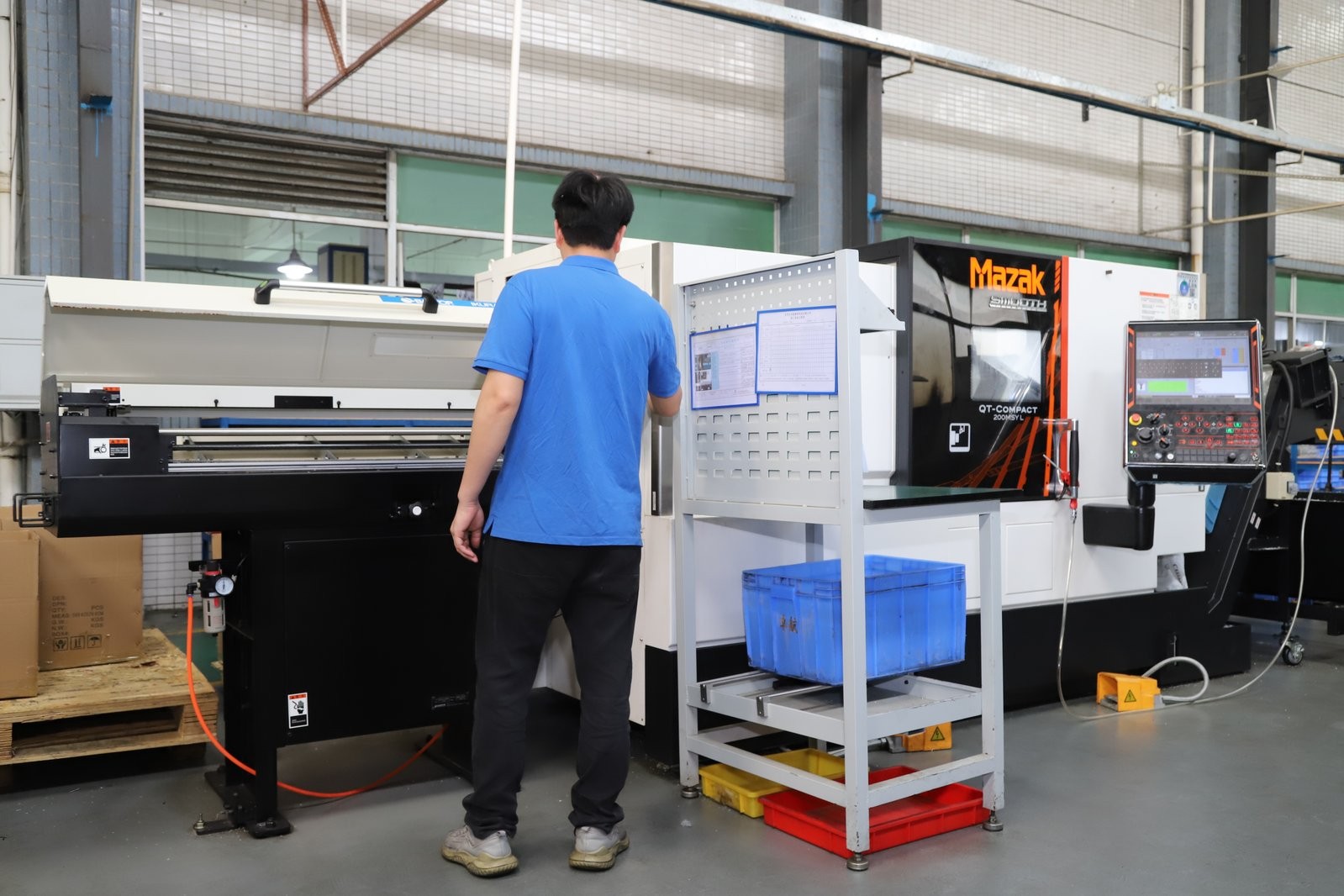
Behind the numbers is a floor you can walk. Dongguan Zhuohang Ltd runs 100+ CNC machines - the Mazak VARIAXIS I-600 five-axis, the INTEGREX I-250H S mill-turn, Brother SPEEDIO, and TSUGAMI, STAR and CITIZEN Swiss lathes - across 6,800 m² in Hengli Town, Dongguan. Every critical feature is checked on a Hexagon CMM under the 10:1 gauge rule, and the certificate numbers for ISO 9001:2015, IATF 16949:2016 and ISO 14001:2015 are published and verifiable. Capability is tracked with Ppk 1.67 or better at the initial study and Cpk 1.33 or better in production, which is the difference between a tolerance that is quoted and a tolerance that is held.
The same floor serves buyers worldwide - Austria, Belgium, the Czech Republic, Denmark, France, Germany, Greece, Hungary, Ireland, Italy, the Netherlands, Spain, Sweden and the United Kingdom in Europe; Brazil, Canada, Mexico and the United States in the Americas; China, Israel, Japan, Singapore and Sri Lanka in Asia; Australia and New Zealand in Oceania; and South Africa in Africa - with shipping from Dongguan. MOQ is 1 piece and lead times run roughly 3 / 7 / 30 days depending on material and documentation. Send the drawing and the quantity to Felipe Iglesias at [email protected] or +86 13126536955, and the quote comes back with the process behind it.
Your next step
A drawing and a quantity are all it takes to turn this page into a real part. Send a STEP or IGES model plus a 2D drawing carrying the tolerances, datums, material grade and finish, and name the quantity and the lead time. That returns an itemised quote - material, setup, cycle time, inspection - instead of a round number. If the drawing is not done, send what exists and the questions holding you back; starting the conversation matters more than waiting for a perfect package.
Reach Felipe Iglesias at [email protected] or +86 13126536955. MOQ is 1 piece, lead times run roughly 3 / 7 / 30 days, and the service area covers Austria, Belgium, the Czech Republic, Denmark, France, Germany, Greece, Hungary, Ireland, Italy, the Netherlands, Spain, Sweden and the United Kingdom in Europe; Brazil, Canada, Mexico and the United States in the Americas; China, Israel, Japan, Singapore and Sri Lanka in Asia; Australia and New Zealand in Oceania; and South Africa in Africa, with worldwide shipping from Dongguan.
Tolerances and finishes, in one reference
Milling holds ±0.003 mm, turning ±0.002 mm, and grinding or wire EDM ±0.002 mm, each verified on a Hexagon CMM against the datum scheme on the drawing. Surface finishes run Ra 0.8 to 3.2 µm as-milled, Ra 0.2 to 0.4 µm ground, and Ra 0.05 to 0.1 µm polished. The 10:1 gauge rule applies to every feature - the instrument resolves ten times finer than the tolerance it checks. And a part is only as good as its datum: the same callout read against two different datums yields two different parts, so name the datum and the convention, ASME Y14.5 or ISO, on the drawing.
De-risking a first order
If this is a first order, a small trial run is the cheapest way to de-risk: a few parts shipped with the drawing and the inspection report, so the routing, the tolerance and the documentation are proven before volume commits. The same floor, the same CMM and the same certificates cover one piece and a thousand alike, so the trial result carries straight into the production run.
What this shop actually runs
Ask for capability evidence and the answer should be specific. The facility behind this guide runs 100+ CNC machines on a 6,800 m2 floor in Dongguan, China, with 100+ staff. The machine list, by category:
- 5-axis machining centres (10+) - Mazak VARIAXIS I-600 (510/910/510 mm travel, 12,000 rpm, 22 kW, 71.6 N·m, 30-tool BT40) and Mazak INTEGREX I-250H S (B-axis 0.0001°, 24 kW, 124 N·m, 38-tool HSK-A63). Set up for compound-angle parts, single-setup multi-face prismatic work, and aerospace fittings where datum transfer loss is unacceptable.
- 3-axis / 4-axis machining centres (50+) - Brother SPEEDIO S500Z2N / S700Z2N (10,000 rpm, 14/21-tool ATC, 0.7 s tool-to-tool, Z-axis 2.2 G) and Mazak VCE-430A L / VCE-570C L (10,000 rpm, 118 N·m, 24-tool ATC). Set up for prismatic parts, plates, brackets, housings.
- Swiss-type turning centres (10+) - Citizen Cincom A20-3F7 (Φ20 mm, 10,000 rpm), TSUGAMI B0206-III / B0205-III (Φ20 mm, 0.1 µm), STAR SR-32JII / SR-32J Type N (Φ32 mm, 8,000 rpm). Set up for long, slender rotational parts at ±0.002 mm.
- CNC turning centres (20+) - HEADMAN T70M/1250 (720 mm swing, 117 mm bore, 3,000 rpm, BMT75 12-station turret). Set up for shafts, bushings, flanges up to ±0.002 mm.
- Wire EDM (5+) - Sodick AQ535L (550/350/300 mm travel, ±20° taper, 800 kg workpiece). Set up for hardened tool steel, internal splines, sharp internal corners that milling cannot reach.
- Inspection: Hexagon CMM + 20+ gauges - Hexagon CMM for coordinate measurement, plus vision system, profilometer, hardness tester, coating thickness gauge, XRF for material verification. The 10:1 rule (gauge 10x more accurate than the band) is applied to every feature.
- Machine highlights - VARIAXIS I-600: one-setup multi-face 5-axis + MAZA-CHECK auto-calibration; INTEGREX I-250H S: DONE-IN-ONE mill-turn, B-axis 0.0001° + Ai thermal shield; SPEEDIO S500Z2N / S700Z2N: Z-axis 2.2 G + 0.7 s ATC; Swiss-type: guide-bush switchable + 0.1 µm resolution.
Tolerances held: milling ±0.003 mm, turning ±0.002 mm, grinding and wire EDM ±0.002 mm. Capability: Ppk >= 1.67 initial and Cpk >= 1.33 in production on key characteristics.
Certifications: ISO 9001:2015 (116024/A/0001/UK/En), IATF 16949:2016 (131941/A/0001/SM/En, clause 8.3 design excluded, disclosed openly) and ISO 14001:2015 (116024/B/0001/UK/En), issued to Dongguan Zhuohang Ltd, USCC 91441900MA4UWT6X39, established 2005.
Service area: Austria, Belgium, the Czech Republic, Denmark, France, Germany, Greece, Hungary, Ireland, Italy, the Netherlands, Spain, Sweden and the United Kingdom in Europe; Brazil, Canada, Mexico and the United States in the Americas; China, Israel, Japan, Singapore and Sri Lanka in Asia; Australia and New Zealand in Oceania; and South Africa in Africa — built in China, shipped worldwide.
Contact: Felipe Iglesias, [email protected], +86 13126536955.
Not sure this is the right process?
Send the model and the drawing and get a straight answer on whether this route is the right one, including where a design change would cut cost. Reach Felipe Iglesias at [email protected] or +86 13126536955.
Frequently Asked Questions
How is material traceability maintained?
Incoming stock is checked against the mill certificate — composition by XRF, hardness where specified — and traceability is held per heat or per batch as the certificate defines it.
Are you a manufacturer or a trading company?
A manufacturer. The legal entity is Dongguan Zhuohang Ltd (Registration No. 91441900MA4UWT6X39), operating a 6,800 m² facility with a floor of 100-plus machines and 100+ staff in Dongguan. Factory visits are welcome.
What is the minimum order quantity for swiss machining?
There is no minimum. Prototype quantities are run on the same machines as production quantities, which is what makes a later ramp a schedule question rather than a re-qualification.
Is your IATF 16949 certificate valid for design work?
No. The certificate excludes clause 8.3 (product design). The plant is certified to manufacture to your design and to run the associated process controls, not to originate product design.
What files do you need for a quote?
In short, A 3D model (STEP or IGES) with a 2D drawing carrying the tolerances, surface finish callouts, material spec and any inspection or certification requirements. The drawing defines the contract — the model alone usually leaves the tolerance scheme unspecified.
Can you work to ASME Y14.5 as well as ISO?
Yes. Both geometric dimensioning conventions are used. The important thing is that the drawing states which one applies, because a single symbol is not interpreted identically under the two standards.
Do you hold stock or consignment for repeat orders?
Repeat orders can run against a forecast so stock and, where the part warrants it, dedicated fixturing are held ready. This is a commercial arrangement, not a standard term, so raise it at the second order rather than the first.
Continue reading: 3 Axis Swiss Machining · 4 Axis Swiss Machining · 5 Axis Swiss Machining
Standards referenced on this page
- ASTM A582/A582M-12 — Standard Specification for Free-Machining Stainless Steel Bars
- ISO 9001 — Quality management systems — Requirements
- ASTM E8/E8M-21 — Standard Test Methods for Tension Testing of Metallic Materials